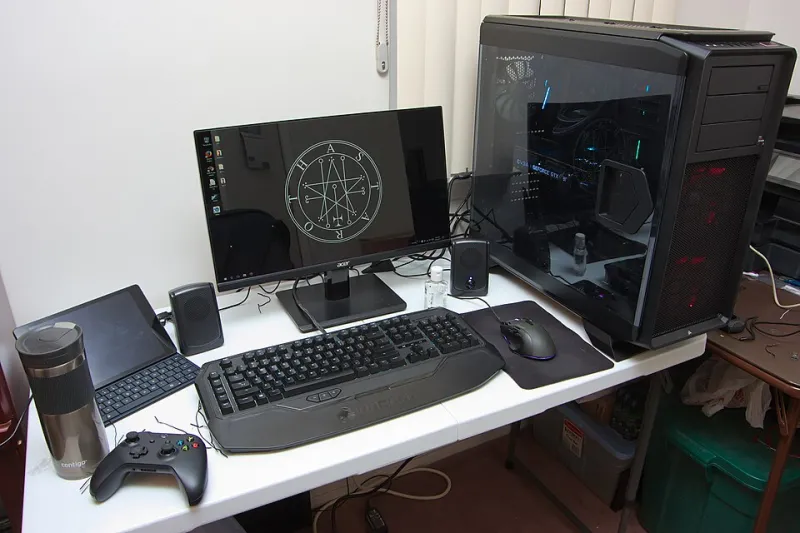
The $500 Unfiltered AI Rig: A No-Regrets Shopping List for Running Uncensored Models at Home
Photo: FreeMediaKid!, CC BY-SA 4.0, via Wikimedia Commons
There's a moment every AI tinkerer eventually hits. You're mid-conversation with some hosted chatbot and it refuses something completely harmless, or it's been so sanitized it now hedges every sentence to death. And you think: I just want a model that does what I say.
Good news: for about the price of a mid-range phone, you can build exactly that. A machine that runs open-weight models locally—no API bills, no terms of service, no logging, no filter layer between you and the weights. Here's how we'd spend $500, based on building and rebuilding this exact setup over the past year.
Why $500 Is the Sweet Spot
Below $300, you're stuck running tiny 3B–7B models that get frustrating fast. Above $800, you're in used-workstation territory with diminishing returns for chat use. The $500 range lands you a GPU that comfortably runs quantized 12B–14B models—big enough to be genuinely smart, small enough to run on a normal home power outlet.
The Build: Where Every Dollar Goes
GPU: Used RTX 3060 12GB (~$220–260 on eBay)
This is the heart of the build. Don't chase the newest card—chase VRAM. The 3060's 12GB lets you run 12B–14B models at 4-bit quantization with room for decent context. Used mining-era cards are cheap because miners ran them conservatively; check for artifacting with a quick FurMark test after purchase.
If you find a used RTX 3090 (24GB) near your ceiling, grab it—but realistically it pushes you past $600 once you factor a beefier PSU.
CPU + Motherboard: Ryzen 5 5600 + B550 board (~$200 combo)
Micro Center runs bundle deals on these constantly—if you live near one of their stores, this is the single best value in US PC building right now. The CPU mostly just feeds the GPU; anything modern with six cores is plenty.
RAM: 32GB DDR4 (~$55)
Local LLM inference loves RAM for model loading and CPU offloading. 16GB works, 32GB removes a whole category of headaches.
Storage: 1TB NVMe (~$50)
Models are big. A 14B quant is 7–8GB, and you'll hoard a dozen before you know it.
Case + PSU: (~$70)
Any ATX case with airflow and a solid 650W 80+ Bronze unit. Don't cheap out on the PSU with a used GPU in the house.
Total: roughly $495–535 depending on the day and your eBay patience.
The Models: What to Actually Download
Skip the hype cycles. On 12GB VRAM, your 2025 shortlist:
- Mistral Nemo 12B (uncensored fine-tunes widely available) – the best personality-per-gigabyte ratio in this class. Creative, cooperative, follows system prompts like a champ.
- Qwen 2.5 14B at Q4 quantization – sharper at reasoning and coding, slightly stiffer in casual chat.
- Llama 3.1 8B variants – the fallback. Faster than everything above and runs with tons of headroom for long context.
GGUF quants from the usual Hugging Face sources are your friend. Q4_K_M is the sweet spot for quality-to-VRAM on this card. And yes—uncensored abliterated and fine-tuned variants of nearly all of these exist, which is rather the point of owning the hardware.
The Software Stack
Ollama if you want dead-simple: one command, model runs, OpenAI-compatible API exposed locally. LM Studio if you want a GUI and easy quant experimentation.
But for the full 'private companion' experience, pair either backend with SillyTavern as your front end. It's a character-card-driven chat interface that treats system prompts, personas, and conversation memory as first-class citizens. This is where local setups absolutely smoke hosted chatbots—your character card can be 2,000 words of dense instructions and the model will actually honor it, because you control the context window.
The Honest Trade-Offs
Let's not sugarcoat it:
- You're your own IT department. Updates, driver issues, and OOM errors are your problem now.
- It's slower than a data center. Expect 15–35 tokens/second on a 12B model—plenty fast for chat, not instant.
- Smaller models are dumber. A 14B local model won't match frontier hosted models on complex reasoning. For chat, roleplay, brainstorming, and privacy-sensitive tasks? The gap is smaller than you'd think.
- Your power bill ticks up under sustained load—maybe $5–10/month if you're a heavy user.
What you get in exchange: a machine that works during outages, never logs your conversations, never rate-limits you, and answers to exactly one person. For a lot of us, that trade is a no-brainer.
Your First Weekend
Day one: assemble, install Ubuntu or Windows, install Ollama, pull a model. Day two: grab SillyTavern, write a character card, and spend four hours arguing with your new creation about its backstory. Day three: start hoarding quants.
That's the whole journey. Five hundred dollars, one afternoon of building, and a chatbot that finally, truly, belongs to you.